Employment Relationships by Erling Rasmussen
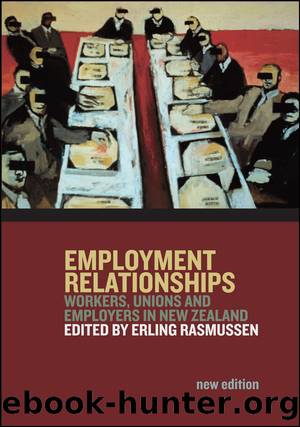
Author:Erling Rasmussen [Rasmussen, Erling]
Language: eng
Format: epub
Tags: Politics and Law
Publisher: Auckland University Press
Published: 2004-01-01T00:00:00+00:00
Employer attitudes toward collective bargaining: survey evidence
In New Zealand, there has been limited research into employersâ attitudes to collective bargaining or even to employment relations matters in general. There was Geareâs 1986 study of industrial relations ideologies where the survey of employer opinions concluded that a pluralist ideology was prevalent amongst managers. However, Geare, Edgar and McAndrew (2006) found 20 years later that the predominant ideology amongst managers had shifted towards a more unitary approach. Earlier studies of employersâ attitudes towards collective bargaining had also concluded that employers preferred national agreements as opposed to enterprise agreements because of the increased costs and greater chances of conflict associated with the latter (McAndrew and Hursthouse 1991). Following the introduction of the Employment Contracts Act, there has clearly been a new context for employer attitudes to collective bargaining. This has continued under the ERA (see the chapters by Blumenfeld and by Burton) and there are now industries which have many workplaces without collective agreements or where collective agreements have little influence.
On the other hand, there appears to have been some shift by employers in their employment relationship strategies towards increased staff communication, workplace participation and workplace partnership. Increased staff communication has been found by surveys since the mid-1990s and is often recommended by management literature (IPMNZ 1997, Rasmussen 1996). Communication efforts have also been associated with a variety of participative structures and many employees appear reasonably satisfied with their influence on workplace decisions (Boxall et al. 2007, Haynes et al. 2005). This has been further buttressed by the introduction of mandatory health and safety committees in larger organisations in the new millennium (see the chapter by Lamm). Furthermore, a Partnership Resource Centre within the Department of Labour was established to encourage unionâmanagement workplace partnership practice in New Zealand. In a comprehensive review, it was found that existing practices were sporadic. However, organisations where employers had had a long-term relationship with unions were more inclined to be involved in collective bargaining processes, compared to employers without a long-term relationship (Ballard and McAndrew 2006, McAndrew 2006).
Against that background, researchers from Massey University and Auckland University of Technology decided to survey employer attitudes toward collective bargaining. This research would explore how much employer attitudes have shifted since the survey of McAndrew and Hursthouse in 1991. It would also investigate whether there is a range of employer attitudes and, if so, what factors are influential in explaining difference.
Download
This site does not store any files on its server. We only index and link to content provided by other sites. Please contact the content providers to delete copyright contents if any and email us, we'll remove relevant links or contents immediately.
The Brazilian Economy since the Great Financial Crisis of 20072008 by Philip Arestis Carolina Troncoso Baltar & Daniela Magalhães Prates(361349)
International Integration of the Brazilian Economy by Elias C. Grivoyannis(111588)
The Art of Coaching by Elena Aguilar(53643)
Flexible Working by Dale Gemma;(23361)
How to Stop Living Paycheck to Paycheck by Avery Breyer(19835)
Thinking, Fast and Slow by Kahneman Daniel(12526)
The Acquirer's Multiple: How the Billionaire Contrarians of Deep Value Beat the Market by Tobias Carlisle(12429)
The Radium Girls by Kate Moore(12179)
The Art of Thinking Clearly by Rolf Dobelli(10717)
Hit Refresh by Satya Nadella(9258)
The Compound Effect by Darren Hardy(9147)
Tools of Titans by Timothy Ferriss(8592)
Atomic Habits: Tiny Changes, Remarkable Results by James Clear(8519)
Turbulence by E. J. Noyes(8207)
A Court of Wings and Ruin by Sarah J. Maas(8108)
Change Your Questions, Change Your Life by Marilee Adams(7931)
Nudge - Improving Decisions about Health, Wealth, and Happiness by Thaler Sunstein(7850)
How to Be a Bawse: A Guide to Conquering Life by Lilly Singh(7613)
Win Bigly by Scott Adams(7344)
